Technical approach Innovation

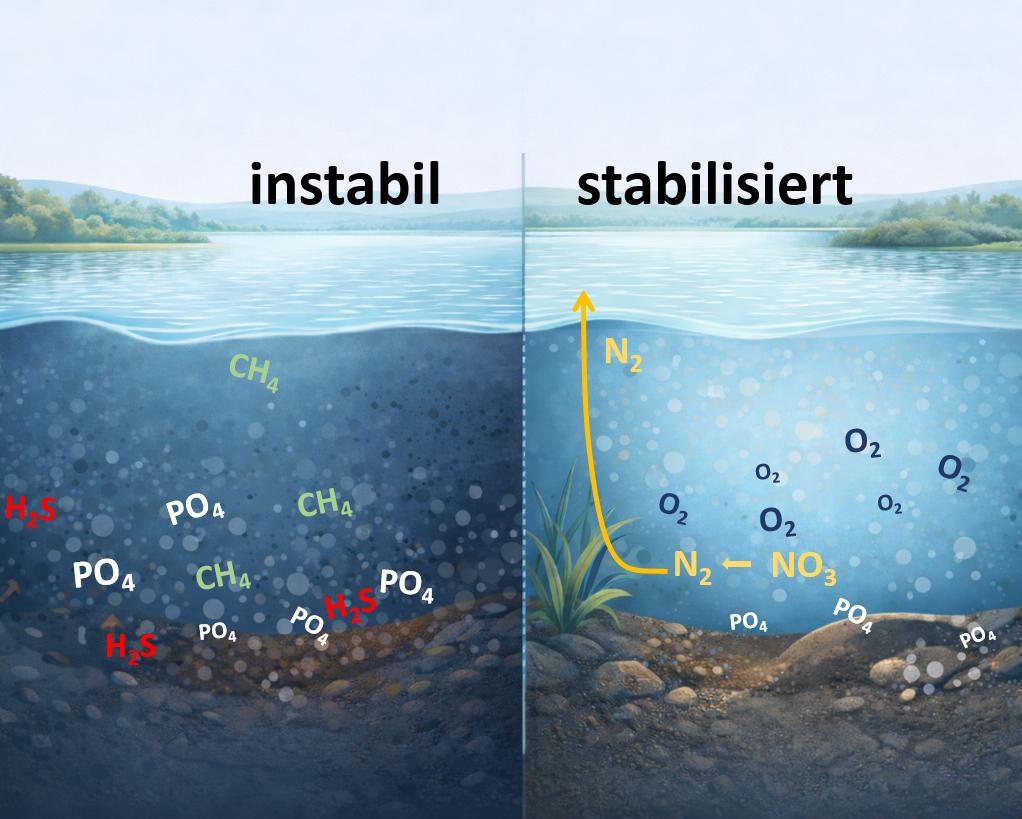
Basic concept of Schäfersee-Verfahren with stable and unstable redox conditions in the sediment

We treat the lake like a patient

Schäfersee-Verfahren® is not conceived as a conventional lake restoration based on one-time technical interventions. Instead, the approach is based on the continuous observation and targeted stabilisation of key biogeochemical processes within the water body. Depending on the state of the system, oxygen and nitrate are introduced into the deep water in a controlled manner in order to stabilise microbial degradation processes in the water column and in the sediment.

Many impacted urban water bodies develop unstable chemical conditions in their deep water and sediments. In these zones, organic matter is continuously decomposed by microorganisms. As long as sufficiently oxidising conditions are present, these processes proceed in a controlled way and without problematic by-products.

However, when oxygen and other electron acceptors are depleted, the system shifts into strongly reducing conditions. Under such circumstances gases such as hydrogen sulphide or methane may form, and previously bound substances can be released again from the sediment. Schäfersee-Verfahren® addresses precisely this point: it stabilises microbial processes where a large part of the internal load originates – in the deep water and directly at the sediment-water interface.

The approach is deliberately cautious. We continuously observe the condition of the water body and support the system only when necessary. This is why we treat the lake like a patient: we measure key “vital” parameters, evaluate the development of the system and respond in a targeted way – no more and no less.
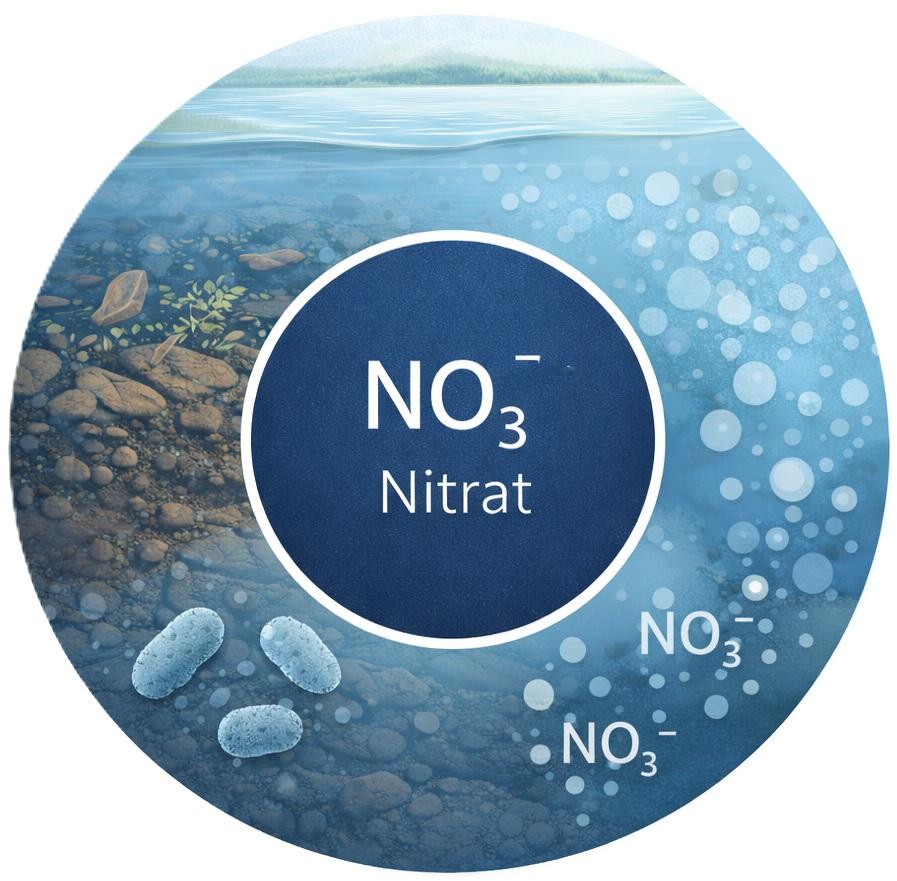
Nitrate as part of the natural nitrogen cycle in water bodies

The role of nitrate

Nitrate is a natural component of the nitrogen cycle in water bodies. It fulfils two different functions there. On the one hand, nitrate serves plants and microorganisms as a nitrogen source for the formation of biomass. On the other hand, bacteria can also use nitrate as an electron acceptor for their energy metabolism.

In public discussions nitrate is often associated exclusively with environmental problems. High and uncontrolled inputs can indeed contribute to eutrophication of water bodies or to groundwater contamination. These effects arise where nitrogen is introduced over large areas and in excess amounts that can no longer be processed by the natural system.

In Schäfersee-Verfahren®, however, nitrate is deliberately used for its second ecological function. Under oxygen-poor conditions many microorganisms can use nitrate instead of oxygen for respiration. As a result, microbial degradation processes remain active even when oxygen concentrations in the deep water or in the sediment are low. In such situations nitrate acts, in a sense, as a second “safety stage” of microbial respiration: when oxygen becomes scarce, metabolism can still proceed in a stable way.

In this process – denitrification – nitrate is gradually reduced to molecular nitrogen (N₂). This nitrogen then escapes into the atmosphere. The nitrate added to the system therefore does not remain permanently in the water body but is microbiologically transformed and removed from the system again.

Controlled dosing is therefore essential. Nitrate is added only in the quantity required for stable microbial degradation processes in the water column and in the sediment. The objective is not nutrient enrichment but the stabilisation of natural metabolic processes in the water body. The concentrations required for this are far below the magnitudes typically associated with agricultural or diffuse nitrogen inputs.

What matters therefore is less the absolute quantity of a single substance than the targeted control of microbial processes in the water body. This requires sound knowledge of the respective dynamics of each water body as well as continuous evaluation of measured condition data. Practical application therefore requires experience in dealing with complex aquatic processes, because although nitrate is part of natural nutrient cycles, inappropriate application can also lead to ecological problems. In Schäfersee-Verfahren® dosing is therefore not based on fixed recipes, but on monitoring data, the condition of the water body and many years of practical experience in the management of impacted aquatic systems.

Important clarification

Key point: In Schäfersee-Verfahren®, nitrate is not used as a nutrient, but as an electron acceptor for microbial degradation.
In Schäfersee-Verfahren®, nitrate is applied in a targeted, demand-based and low-dose manner.
Microorganisms use the nitrate for respiration and convert it into nitrogen gas (N₂).
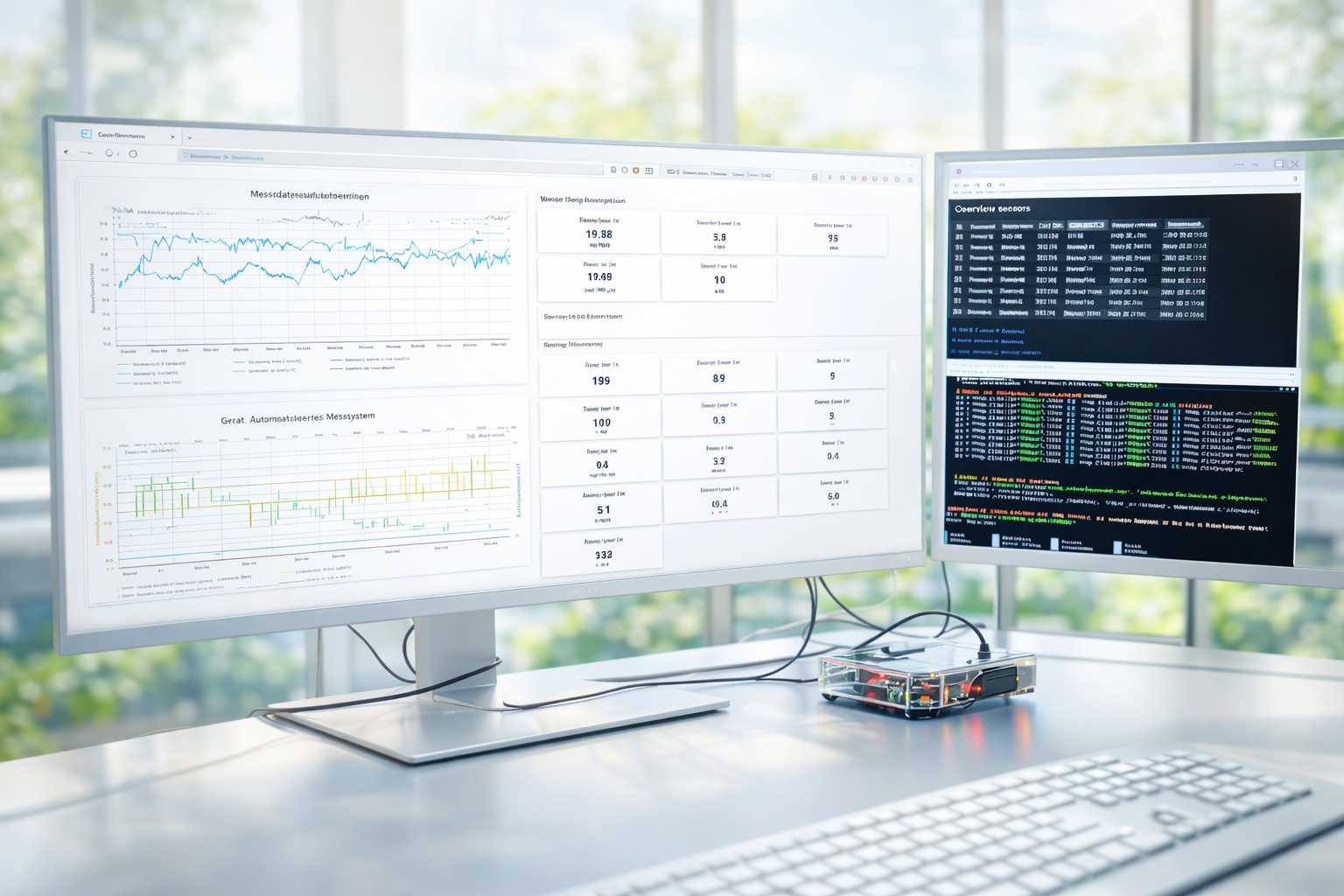
Digital control centre of Schäfersee-Verfahren

The actual innovation of the process

The innovation of Schäfersee-Verfahren® does not lie in the renaming of already known substances. Oxygen and nitrate have long been known components of natural biogeochemical cycles. What is new is the systematic technical monitoring, evaluation and control of these processes.

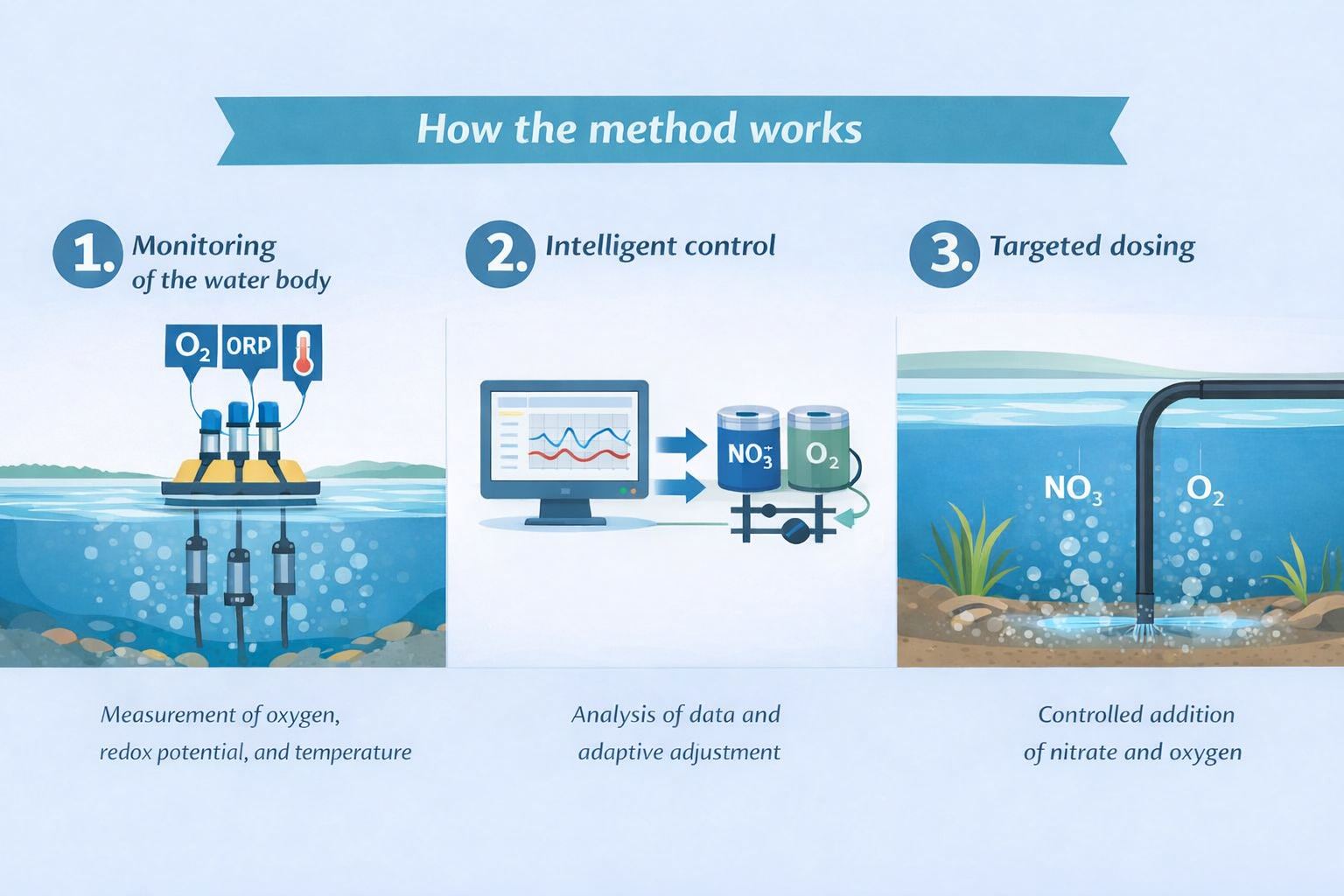
The water body is treated as a dynamic system. Sensors continuously record key parameters such as oxygen, redox potential, temperature, nitrate and ammonium at different water depths. The data are transmitted digitally, evaluated and documented over the long term. In this way, a point measure becomes a genuine real-time observation of processes.

At the same time, this creates a new form of water body management: not reactive, but data-based, precise and transparent. Changes in the system can be detected early and measures can be adapted in a targeted manner.

The combination of continuous monitoring, process-based evaluation and adaptive dosing forms the core of the process. It is based on many years of practical work in impacted water bodies and on experience in interpreting complex limnological processes.

The practical implementation of such systems therefore requires not only technology, but also experience in the evaluation and interpretation of complex aquatic processes.

Intelligent process control

Scheme of intelligent process control with sensor systems, data analysis and dosing

On the basis of these measurements, dosing is controlled. The addition of oxygen and nitrate does not follow a rigid scheme, but depends on the actual condition of the water body. Both substances fulfil different functions in microbial metabolism and are combined in such a way that stable oxidising conditions are maintained in the deep water and at the sediment surface.

The technical implementation combines in-lake online sensors, data transmission, computer-based evaluation and controllable dosing systems. Pumps and injection points can be operated according to actual demand. The process therefore reacts not to assumptions, but to real condition data from the lake.

Especially in heavily impacted water bodies, incorrect dosing or unsuitable interventions can lead to unwanted side effects. Continuous evaluation of monitoring data and adaptation of the operational strategy are therefore a central component of Schäfersee-Verfahren® and a prerequisite for stable and ecologically compatible operation.

The aim is a permanently stable condition of the water body. The lake should neither be technically over-shaped nor chemically over-controlled. Instead, it should be supported in such a way that its natural microbial processes can once again proceed in a controlled way and without the formation of putrefaction gases.

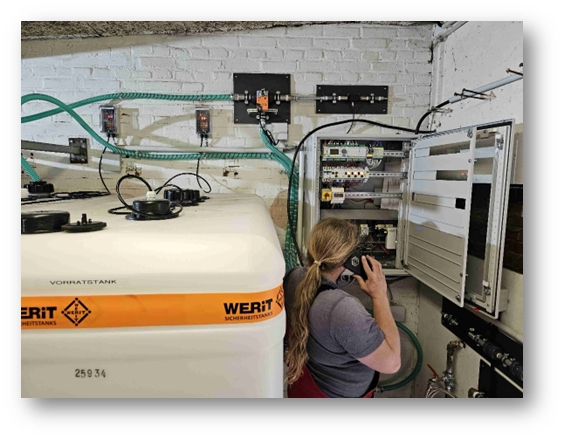
Stationary technical installation with tanks, pumps and control units

Technology on site

On site, the system consists of a compact technical installation with tanks, pumps, pipelines, electronics and the injection points within the water body.

The installations are designed for long-term operation under real water body conditions and are continuously monitored and adapted to the specific requirements of each site.

Depending on the project water body, system layout and dimensioning may differ. The basic principle, however, remains the same: the water body is monitored, the data are evaluated and support is provided only in the amount actually required.

In this way, Schäfersee-Verfahren® combines ecological process knowledge with practical operational technology. It is not an abstract laboratory principle, but an application-oriented system for real water bodies under real impact conditions.

Contact A quick assessment for your water body

Get in touch