Panketal – small stationary system
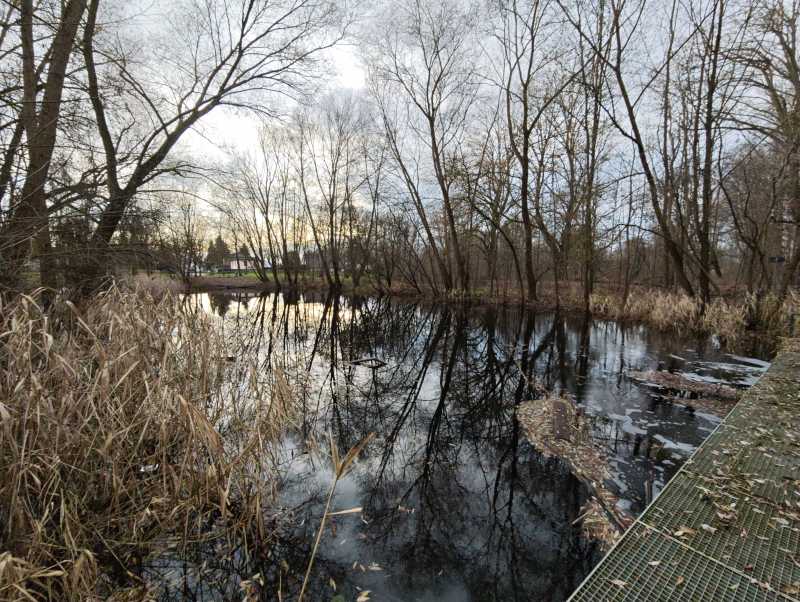
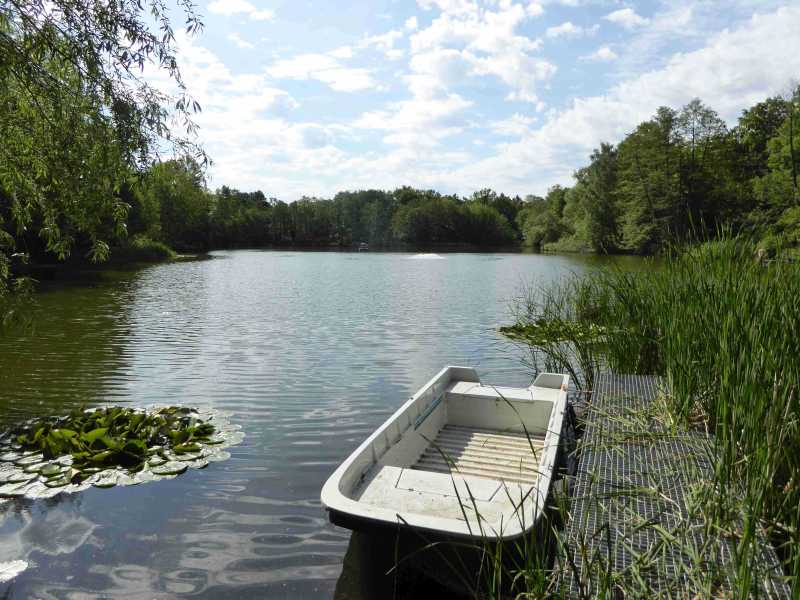
The Panketal site represents a special application case in several respects.
It was here that a fully stationary installation of Schäfersee-Verfahren®
was implemented for the first time. The technical equipment is installed
on land and connected to the monitoring and injection points in the water
body via underground pipelines. At a distance of around 100 metres, control
cabinets house remote transmission, process control and dosing equipment.
From there, monitoring data can be transmitted, operating conditions can
be supervised and the addition of the required substances can be controlled
remotely. This was the first time that a permanently automatable operating
concept for Schäfersee-Verfahren® was realised.
At the same time, the water body itself represents an unusual case of
application. With a depth of only about one and a half to two metres,
it does not develop stable stratification and therefore no hypolimnion –
exactly the lake compartment for which the method was originally developed.
For that very reason, the key question here was whether the targeted
addition of oxygen and nitrate in such a shallow, nutrient-rich water
body could trigger unwanted eutrophication effects. Practical experience
showed, however, that even small dosages effectively buffered oxygen
demand, prevented reducing conditions and permanently suppressed the
hydrogen sulfide formation that had previously occurred regularly.
Algal development did not play a significant role.
Project profile
Location: Panketal
Water body type: small standing water body
Volume: approx. 1,500 m³
Special feature: small stationary system with remote transmission
Problem: strong putrefaction / hydrogen sulfide odour
Status: successfully in operation
System type: stationary shoreline system
Control: online sensors, remote control, pulse dosing